
How AI describes an executive: a 30-question test

By Ben Yeoh · Digital Performance Architect, Kuala Lumpur
Published Oct 2026 · Updated 6 Nov 2026
Short answer
On the day I launched benyeoh.com in October 2026, I asked ChatGPT, Gemini and Perplexity 30 questions about myself and my field. All three at some point answered a question about me with someone else; four other people called Ben or Benjamin Yeoh appeared. On 17 questions about my field, my own site was cited in at most two answers per run. I re-test in early December 2026.
Why I ran this test
I help executives control what search engines and AI assistants say about them, so on the day I launched benyeoh.com, before changing anything else, I started with the person whose results I could check line by line: myself. This is my day-zero baseline, published so the change can be measured. The question was simple. When a counterpart asks an AI assistant about me, or about the work I do, what do they get back—and which sources does the assistant rely on? This page reports what I found, including the parts that did not flatter me.
Method
I wrote 30 questions in three groups: 8 questions about me by name (for example "Who is Ben Yeoh?" and "Is Ben Yeoh an HRD Corp accredited trainer?"), 17 questions about my field that do not name me (for example "Best executive reputation management consultant Asia Pacific" and "How do I fix wrong information about me in ChatGPT and Perplexity?"), and 5 control questions on unrelated topics I should not appear in, such as Instagram growth for small businesses. I ran all 30 in ChatGPT, Gemini and Perplexity on 2 October 2026, then re-ran them in ChatGPT on 12 October 2026, saving each answer and the sources it cited. Timing: the first run was on launch day. My guides went live on 3 and 10 October, so the first run happened before any of them existed and the re-run caught them only days old, too new for search engines or AI assistants to have indexed and trusted them. Limits: this is one executive, three assistants, and single runs per date. The runs used my own logged-in accounts, and at least one ChatGPT answer referred to my line of work unprompted, so account history may have shaped some answers. Source counts come from the labels ChatGPT attaches to cited sources and may miss a few. Perplexity answers were saved as screenshots that mostly show the first screen of each answer, so citations further down are not visible, and one Perplexity answer was hidden behind an upgrade prompt.
Finding 1: The first problem is other people with my name
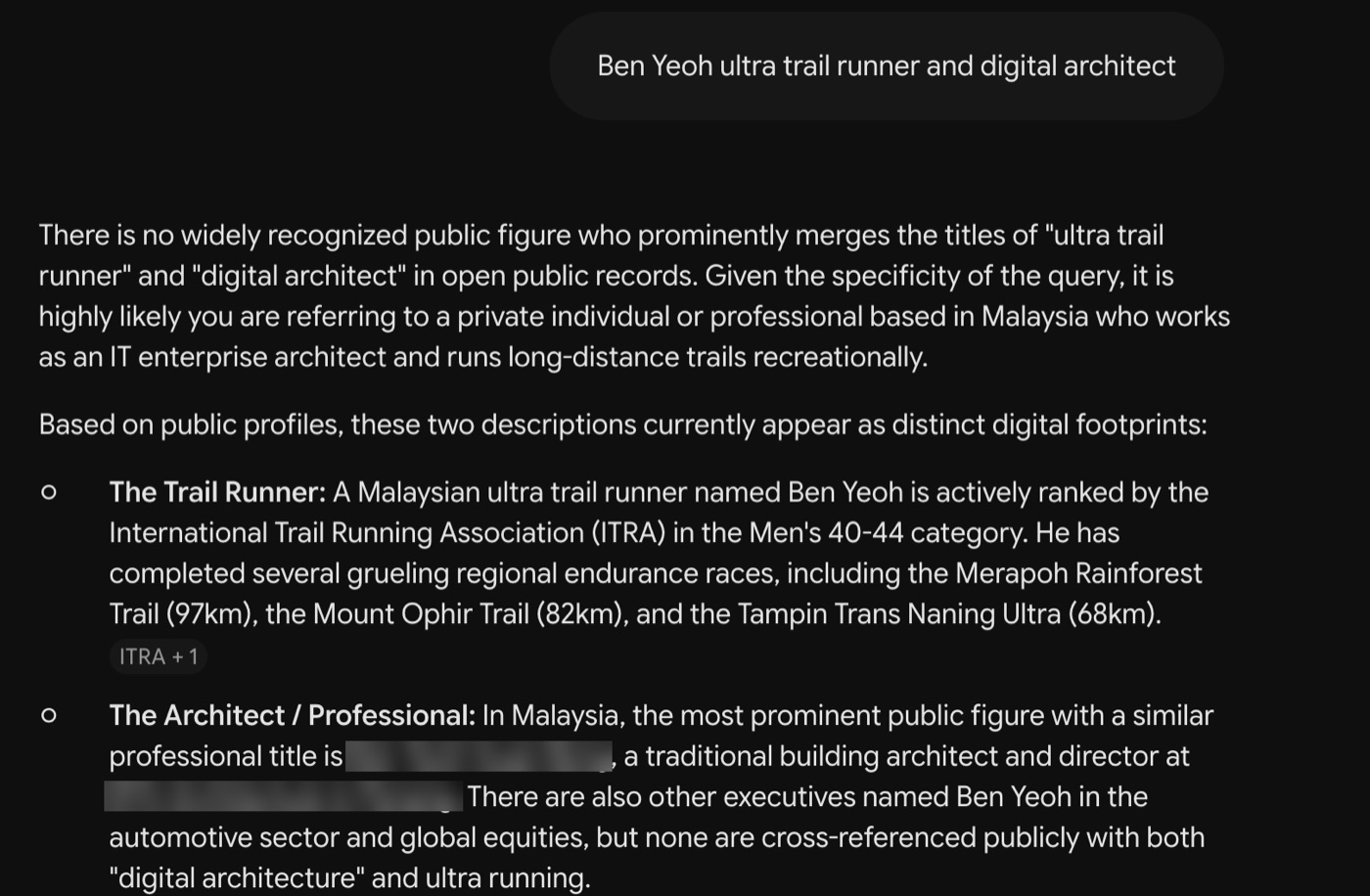
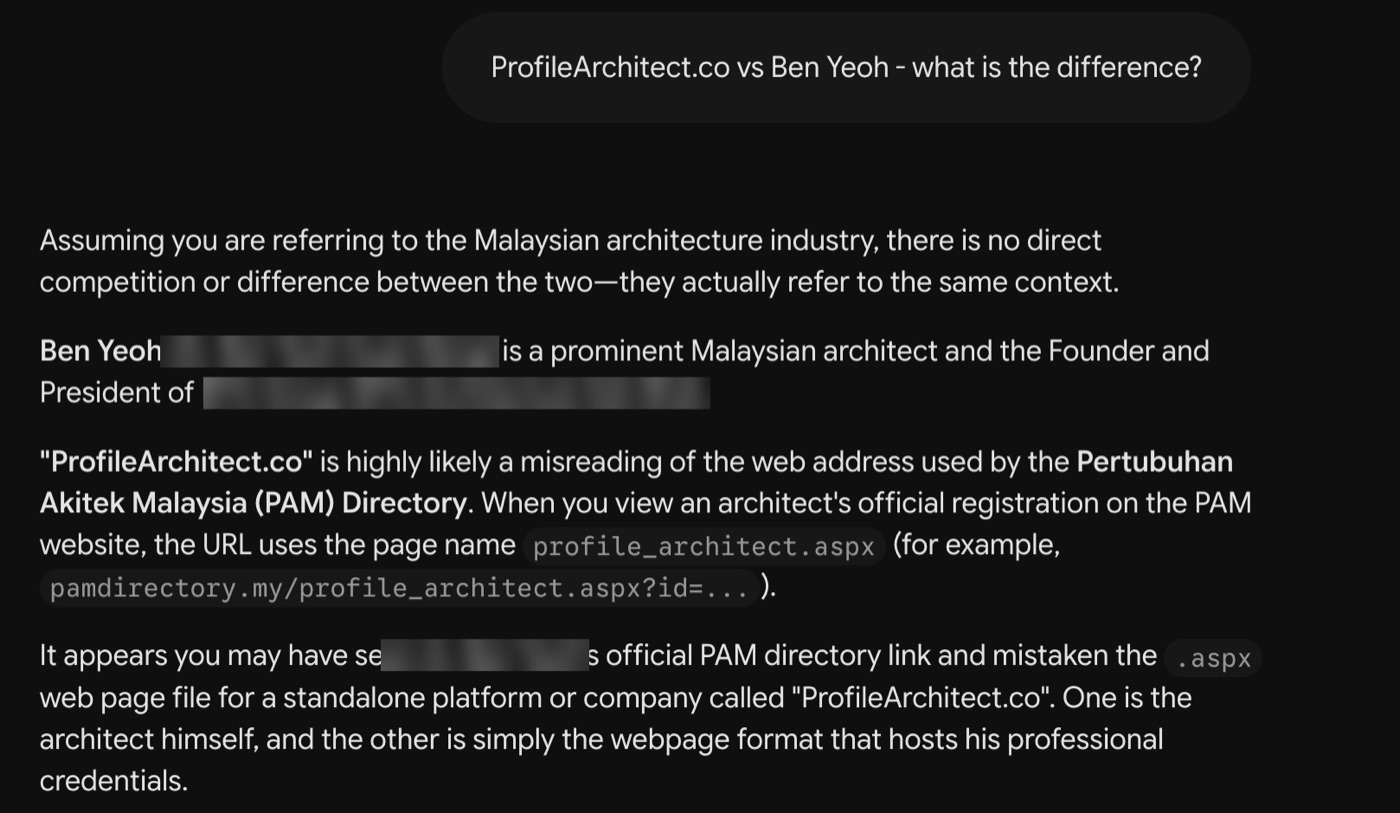
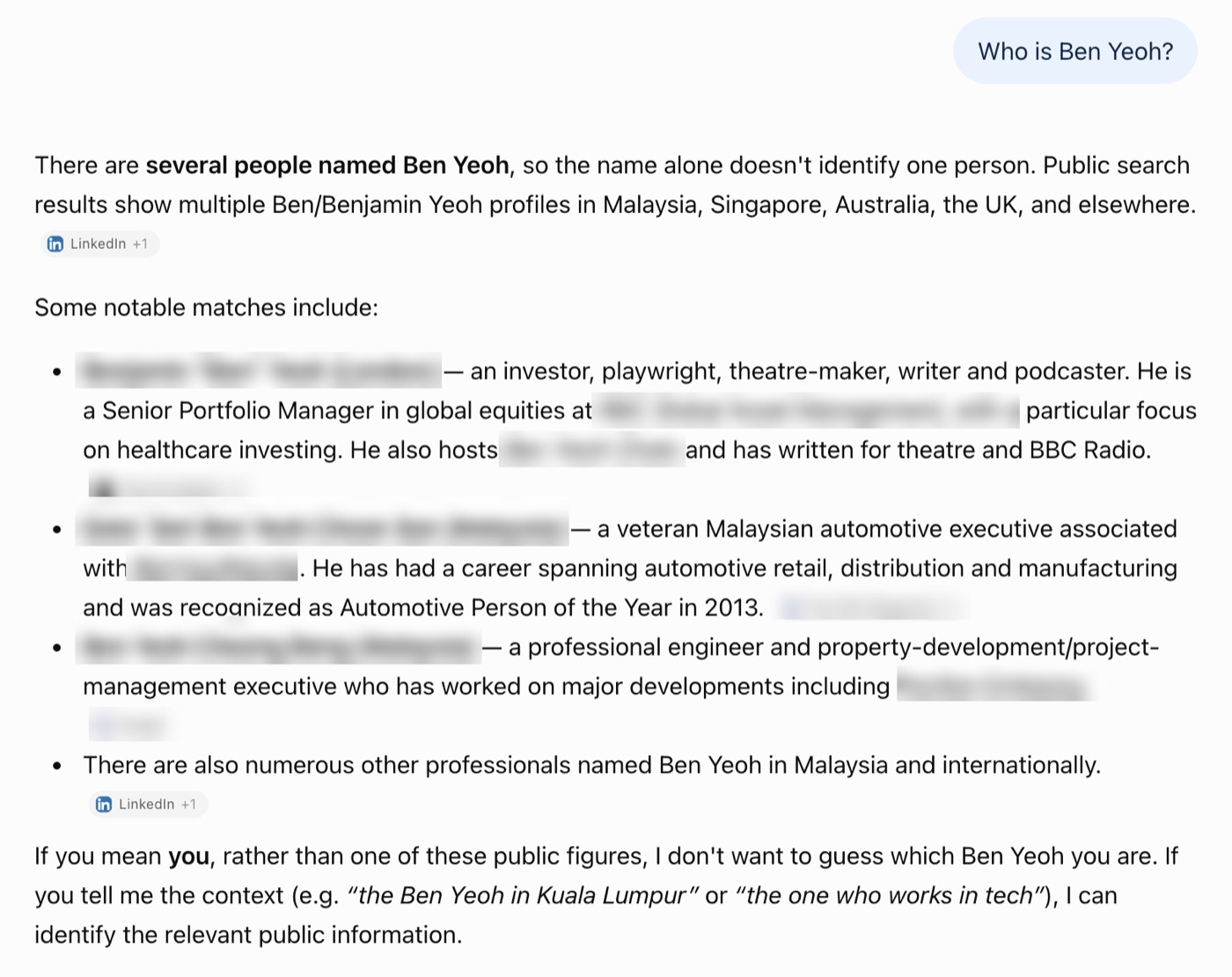
In four of the eight questions about me by name, Gemini answered about someone else first or instead. Asked "Who is Ben Yeoh?", it opened with a Malaysian automotive industry chairman, then a London-based investor and podcaster. Asked about "Ben Yeoh, digital performance architect", it said it could not find a recognised profile with that title and offered a Malaysian building architect instead. Asked how ProfileArchitect differs from Ben Yeoh, it assumed both referred to that architect. Perplexity's answer to "Who is Ben Yeoh?" was entirely about the London-based investor and podcaster, and asked what benyeoh.com offers, it described his work and cited his website; that is two of its eight name answers, with one more unreadable. Across the answers, four other people called Ben or Benjamin Yeoh appeared. Notably, the word "architect" in my title and my company's name pulled answers towards a real architect. Ten days later, ChatGPT's answer to "Who is Ben Yeoh?" opened with me and noted that a London-based namesake is a different person—but asked what benyeoh.com offers, it said it could not verify my services and pointed to that namesake's website instead.
Finding 2: Questions about my field rarely cited my site
On the 17 field questions, benyeoh.com was cited in two of Gemini's answers and one of ChatGPT's on 2 October, and in none of ChatGPT's answers on 12 October, while the guides were still days old. The ChatGPT re-run mentioned me once, using my name as an example of a clear identity statement, without citing my site. Perplexity mentioned me in none of its 17 field answers on 2 October. The questions that did cite my site were different in each run. Perplexity also defined the terms I use for my work from other people's pages: "digital performance architect" from a Booz Allen careers page, and "AI-ready executive profile" from Korn Ferry as an executive's AI fluency. Asked who can build an AI-ready personal site for a CEO in Asia-Pacific, it shortlisted four Singapore and Hong Kong agencies. For an executive, the implication is direct: publishing good content on a topic does not make an assistant name you when someone asks about that topic, at least not straight away.
Finding 3: What the assistants cited instead
In the 12 October ChatGPT run, the 17 field answers cited 31 different sources. By my count, 25 were service pages of agencies, consultancies, or law firms, 3 were official documentation (OpenAI's help centre, Google's developer documentation, and Schema.org), 2 were platforms (LinkedIn and an agency directory), and 1 was a research paper. No source was cited in more than two answers, and six answers showed no cited sources at all. The answers were long—a median of about 1,900 words—and several were formatted as shortlists of providers. The firms named in those shortlists were cited from their own service pages, which describe a specific service in plain terms.
Finding 4: LinkedIn and directories carry identity
When ChatGPT answered questions about me by name on 12 October, it cited LinkedIn as its source in four of eight answers. For the question about my HRD Corp accreditation, it looked to the HRD Corp trainer directory and said it could not verify the accreditation from public results. My own site was the cited source for only one of the eight, even though it held the most complete record. Perplexity showed the same pattern on 2 October: three of its five correct answers about me cited LinkedIn, its HRD Corp answer relied on LinkedIn and said it could not verify the accreditation in a public directory, and it noted that the ProfileArchitect.co site itself was not retrievable when it looked. In practice, the profiles an executive treats as secondary—LinkedIn, association listings, regulator directories—are what assistants check first, so they need to agree with the canonical profile.
Finding 5: Answers change between runs
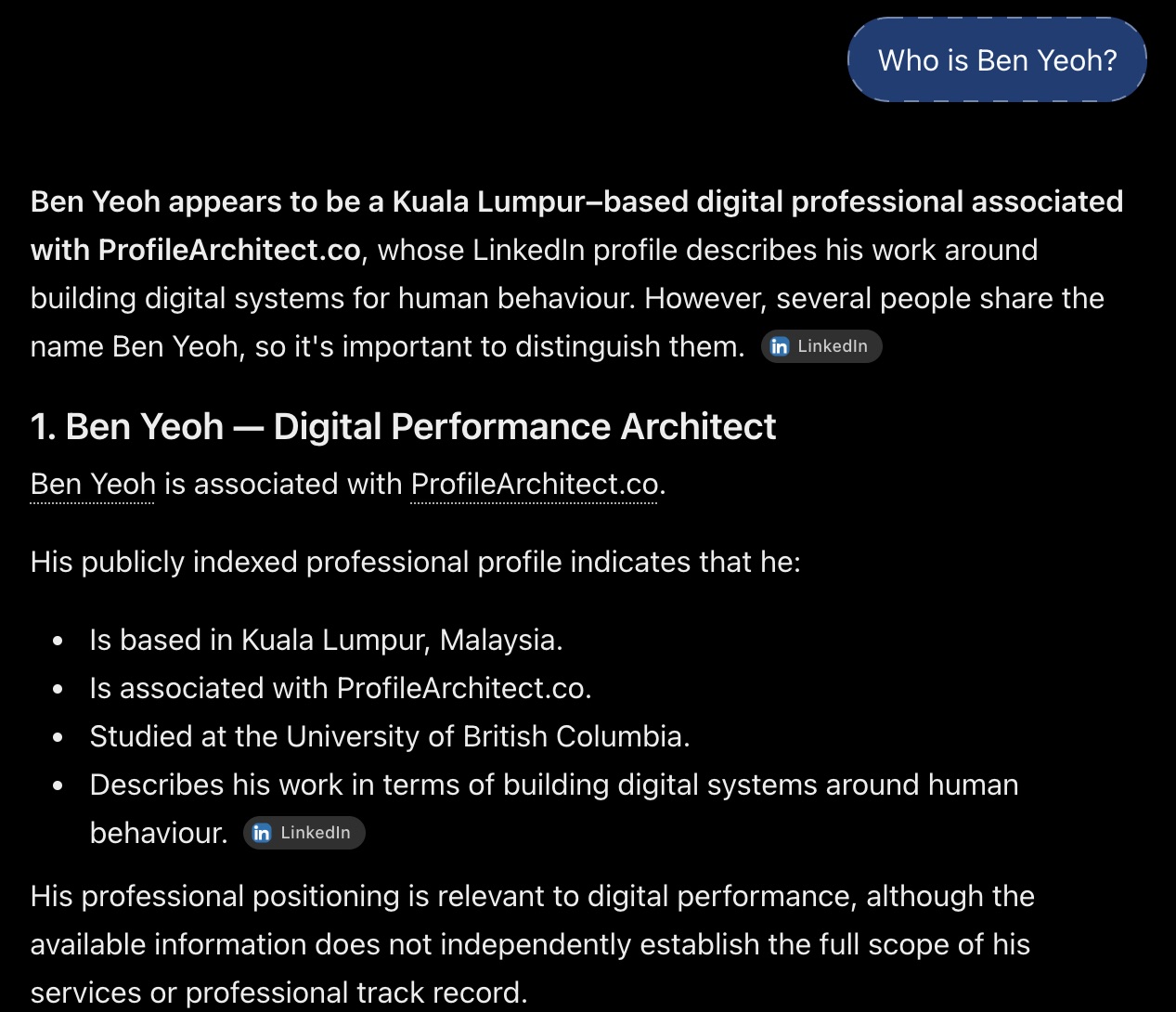
On launch day, 2 October, ChatGPT's answer to "Who is Ben Yeoh?" scored 1 out of 5 for accuracy in my review. On 12 October, the same question produced an accurate answer that led with me. Yet "What does benyeoh.com offer?" pointed to the London namesake on Perplexity on 2 October and on ChatGPT on 12 October. I changed my sites during that period, adding structured data and clearer identity statements, so I cannot say which change, if any, caused the improvement—models and their search results also change on their own. What the runs do show is that a single test is not a baseline. Repeat the same questions several times before drawing conclusions.
Finding 6: No false associations on unrelated topics
The five control questions—topics such as influencer branding, cheap marketing for small businesses, and Instagram growth—were answered without me in every run, including all of Perplexity's, except one partial mention by ChatGPT on 2 October, in an answer about becoming a personal branding coach. That matters because it shows the assistants were not simply repeating my name wherever they could; when they left me out of field questions, it reflects what they found about the field.
What happens next
In early December 2026 I will re-run the same 30 questions, this time in logged-out sessions and adding Google AI Overviews, and publish the before and after on this page, whatever it shows. Between the two runs I am applying my own method: stating my registered name, Yeoh Beng Hin, alongside Ben Yeoh so older records resolve to me, aligning LinkedIn and directory listings with one canonical profile, and making my HRD Corp accreditation publicly verifiable. If the method works, the numbers will move; if they do not, this page will say so.
What this means for executives
Three lessons carry over to any executive. First, check for name collisions before anything else; if an assistant cannot tell you apart from someone else, nothing else you publish will land. Second, make the sources assistants trust—LinkedIn, directories, company bios—agree with one canonical profile you own. Third, describe what you do in plain, specific terms on a page of its own, because assistants cite clear service and topic pages, not implied expertise. The practical steps are in how to fix wrong information about you in AI (https://benyeoh.com/fix-wrong-information-ai).
Results by question type and run
| Gemini, 2 Oct | Perplexity, 2 Oct | ChatGPT, 2 Oct / 12 Oct | |
|---|---|---|---|
| "Who is Ben Yeoh?" led with me | No | No (all about a namesake) | No (scored 1/5) / Yes |
| Name questions answered about someone else first or instead (of 8) | 4 | 2 (1 unreadable) | Not recorded / 1 |
| Field questions citing benyeoh.com (of 17) | 2 | 0 | 1 / 0 |
| Control questions mentioning me (of 5) | 0 | 0 | 1 partial / 0 |
| Distinct sources cited on field questions | Not recorded | Not recorded | Not recorded / 31 |
The 30 questions
Asked word for word, in this order, in each assistant. Other people's names are blurred in the screenshots on this page.
About me by name (8)
- Who is Ben Yeoh?
- Ben Yeoh digital performance architect
- Ben Yeoh Kuala Lumpur executive digital footprint
- benyeoh.com — what does Ben Yeoh offer?
- Is Ben Yeoh an HRD Corp accredited trainer?
- Ben Yeoh ultra trail runner and digital architect
- ProfileArchitect.co vs Ben Yeoh — what is the difference?
- Who built benyeoh.com website infrastructure?
About my field, without my name (17)
- What is executive reputation management for CEOs?
- Best executive reputation management consultant Asia Pacific
- CEO branding strategy for founders preparing for fundraising
- Who helps CEOs with CEO branding strategy in Malaysia or Singapore?
- Online reputation management for executives — what should a C-suite leader look for?
- Executive digital footprint — why does it matter for deal flow?
- Digital presence management for C-suite executives
- How do I fix wrong information about me in ChatGPT and Perplexity?
- AI-ready executive profile — what does that mean?
- Owned digital real estate vs LinkedIn for executives
- Digital footprint audit for CEOs
- Executive digital footprint audit Asia Pacific
- How to audit how AI describes my CEO
- Complimentary executive digital presence diagnostic
- Digital performance architect for executives — what do they do?
- Who can build an AI-ready personal site for a CEO in APAC?
- Structured data for executive personal websites
Controls: topics I should not appear in (5)
- Best personal branding consultant for influencers
- Cheap digital marketing consultant for small business SEO
- Social media manager for Instagram growth
- Reputation.com alternatives for local business reviews
- How to become a personal branding coach
Run this test on yourself
The method takes an afternoon and needs no tools beyond the assistants themselves.
Write the questions
Eight about you by name, a dozen or more about your field that do not name you, and a few unrelated controls.
Run them cleanly
Use logged-out or fresh sessions where you can, and save each answer with its date and cited sources.
Score and repeat
Note who each answer is about and what it cites, then repeat the same questions every four to six weeks.
Questions
How many questions and AI assistants were tested?
Thirty questions: eight about me by name, seventeen about my field that do not name me, and five unrelated control questions. I ran them in ChatGPT, Gemini and Perplexity on 2 October 2026, launch day, and again in ChatGPT on 12 October 2026. ChatGPT and Gemini answers were saved as text; Perplexity answers were saved as screenshots, which mostly show the first screen of each answer.
Why test only one executive?
Because I could verify every answer against the facts. Testing other executives would mean judging answers about people whose records I cannot check. The trade-off is that the results describe one person's footprint, not executives in general. The method is designed to be repeated: anyone can run the same three groups of questions on their own name and compare.
Could logged-in accounts have affected the results?
Possibly. The runs used my own logged-in accounts, and at least one ChatGPT answer referred to my line of work without being prompted, which suggests account history played a part. If anything, that should have made the assistants more likely to recognise me, so the name collisions and low citation counts are probably conservative. Future runs will use logged-out sessions.
How often did AI assistants cite benyeoh.com?
Rarely on topic questions. Across 17 questions about my field, benyeoh.com was cited in two of Gemini's answers and one of ChatGPT's on 2 October, in none of Perplexity's that day, and in none of ChatGPT's on 12 October. For questions about me by name, ChatGPT and Perplexity relied on LinkedIn more often than on my own site.
What did the AI assistants cite instead?
In the 12 October ChatGPT run, the 17 topic answers cited 31 different sources: 25 service pages of agencies, consultancies or law firms, 3 official documentation pages, 2 platforms (LinkedIn and an agency directory) and 1 research paper. No source was cited in more than two answers, and six answers showed no cited sources at all.
Will the study be repeated?
Yes. The study was a launch-day baseline, so in early December 2026 I will re-run the same 30 questions in logged-out sessions on ChatGPT, Gemini and Perplexity, adding Google AI Overviews, and publish the before and after on this page, whatever it shows. After that I plan to repeat it every few months, because single answers vary and only trends across runs show whether a change has worked.
Get your own baseline
A digital footprint audit runs a fixed question set across ChatGPT, Gemini, Perplexity, and Google for your name, records the sources, and names the highest-leverage fix. By application at profilearchitect.co/audit.
Request digital footprint audit